Annual public record · 2026 edition · California
The state of California therapy work—without pretending the gaps are facts.
A source-by-source account of who is registered, how the three BBS routes differ, what the education and safety-net records show, and what California still does not publish well enough to claim.
Workforce →Read this as a measured record, not a ranking.
The report keeps each source in its own unit. License records are not people; federal designations are not jobs; selected discipline decisions are not violation rates; program listings are not enrollment capacity.
Why publish the missing column?
California therapist compensation is not reportable as one statewide figure from this project. The site does not collect compensation submissions; public employer records and browser-local decision tools remain separate.
01 · Workforce register
165,235 records does not mean 165,235 working therapists.
The August 2026 DCA file includes licensed, associate, temporary, delinquent, and inactive records. The status split is the first necessary correction to the headline.
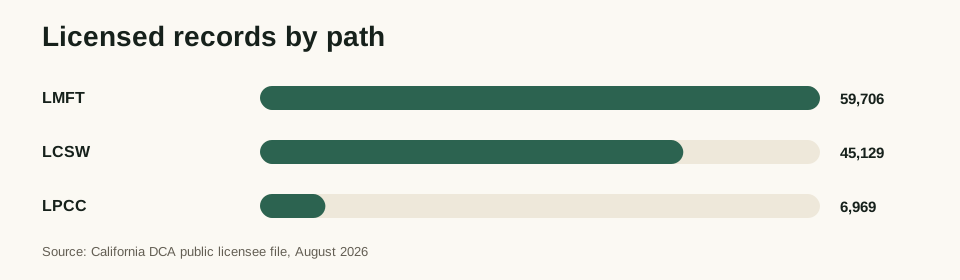
Licensed records by the three largest BBS therapy paths
August 2026 DCA public licensee file; record counts, not unique people or FTEs.
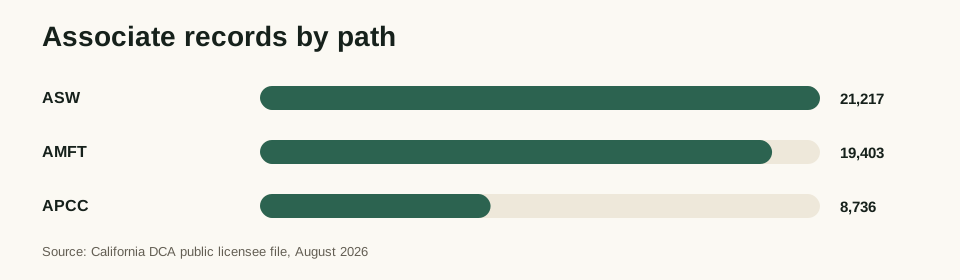
Associate records by path
The three associate registrations in the same monthly file.
02 · Three routes
The shared 3,000-hour headline conceals consequential differences.
All three paths require 3,000 experience hours across at least 104 weeks, but their clinical minimums, pre-degree treatment, special subminimums, and final exams differ.
| License | Associate | Direct clinical minimum | Pre-degree maximum | Clinical exam |
|---|---|---|---|---|
| LMFT | AMFT | 1,750 | 1,300 | California LMFT Clinical Examination |
| LCSW | ASW | 2,000 | None | ASWB Clinical Examination |
| LPCC | APCC | 1,750 | None | National Clinical Mental Health Counselor Examination (NCMHCE) |
Rules checked against BBS materials on 28 August 2026. Special subminimums still apply; use the license-specific planner before acting.
Plan against the requirements for your license.
A total of 3,000 hours is only part of the picture. Choose LMFT, LCSW or LPCC in the planner to see the categories that apply to that path. Each saved plan identifies its license and controlling BBS sources.
03 · Education and public systems
The infrastructure is statewide; the evidence is not one denominator.
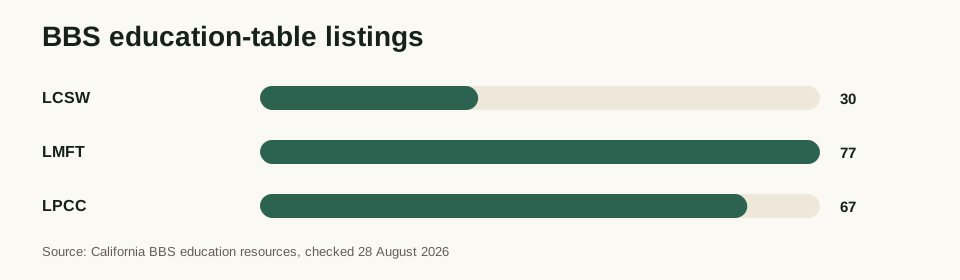
BBS education-table listings by path
A school may be listed for multiple paths; these columns must not be added and called schools.
Search the BBS education table → · Inspect the safety-net employer evidence → · Open the 58-county job-search workspace →
04 · Discipline lens
Forty-eight decisions can teach patterns. They cannot establish rates.
This de-identified teaching set was transcribed from signed BBS decisions. It is deliberately useful for recognizing failure modes and deliberately unsuitable for estimating how often misconduct occurs.
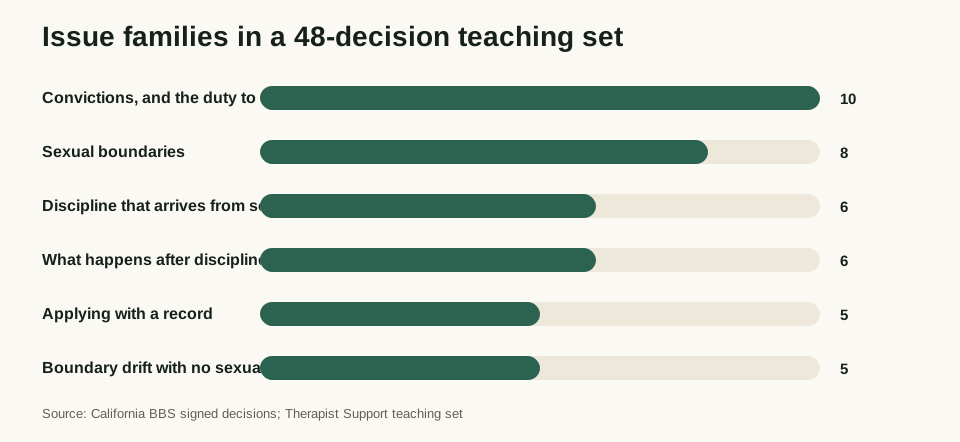
Most common issue families inside the teaching set
Counts within 48 selected decisions; categories are editorial teaching labels, not statewide incidence.
The denominator is the teaching set—nothing larger.
No comparison is made with all licensees, all complaints, all investigations, or all Board actions. Selection, publication, and enforcement processes prevent a valid rate calculation.
05 · Known gaps
What this edition refuses to invent.
The site does not collect compensation submissions and does not present a salary, split, rate, or take-home estimate as one statewide finding.
A license address, shortage designation, directory listing, or referral signal does not prove that a clinician has an opening.
License records can duplicate people across credentials and statuses. This report counts records and says so.
The data describes administrative records. It does not explain why a status changed, why a county ratio differs, or why an exam rate moved.
The teaching set is selected and de-identified. It supports education, not incidence or comparison among license types.
06 · Method, sources, and reuse
Every headline keeps its unit attached.
- Prefer controlling public records. DCA, BBS, and HRSA files and packets are used before summaries.
- Keep clocks separate. The August monthly register is not spliced into the Board’s Q3 FY 2025/26 operational series.
- Keep denominators separate. Records, schools, path listings, exams, applications, sites, designations, and selected decisions are not combined.
- Publish negative space. Missing compensation remains missing; private figures are not collected to manufacture an answer.
- Make correction possible. Checked dates, machine data, and the Evidence Desk expose what must be rechecked.
Download and cite
https://www.dca.ca.gov/consumers/public_info/index.shtml
https://bbs.ca.gov/about/board_meetings.html
https://www.bbs.ca.gov/applicants/education_resources.html
https://www.bbs.ca.gov/licensees/manage.html
https://data.hrsa.gov/data/download
https://www.bbs.ca.gov/resources/general.html
Suggested citation: Therapist Support. State of California Therapy Work 2026. Published 28 August 2026. This report is informational, not legal, clinical, employment, or financial advice.